Case study · 2025
MCP Gateway Catalog: one catalog, many tools, unified auth
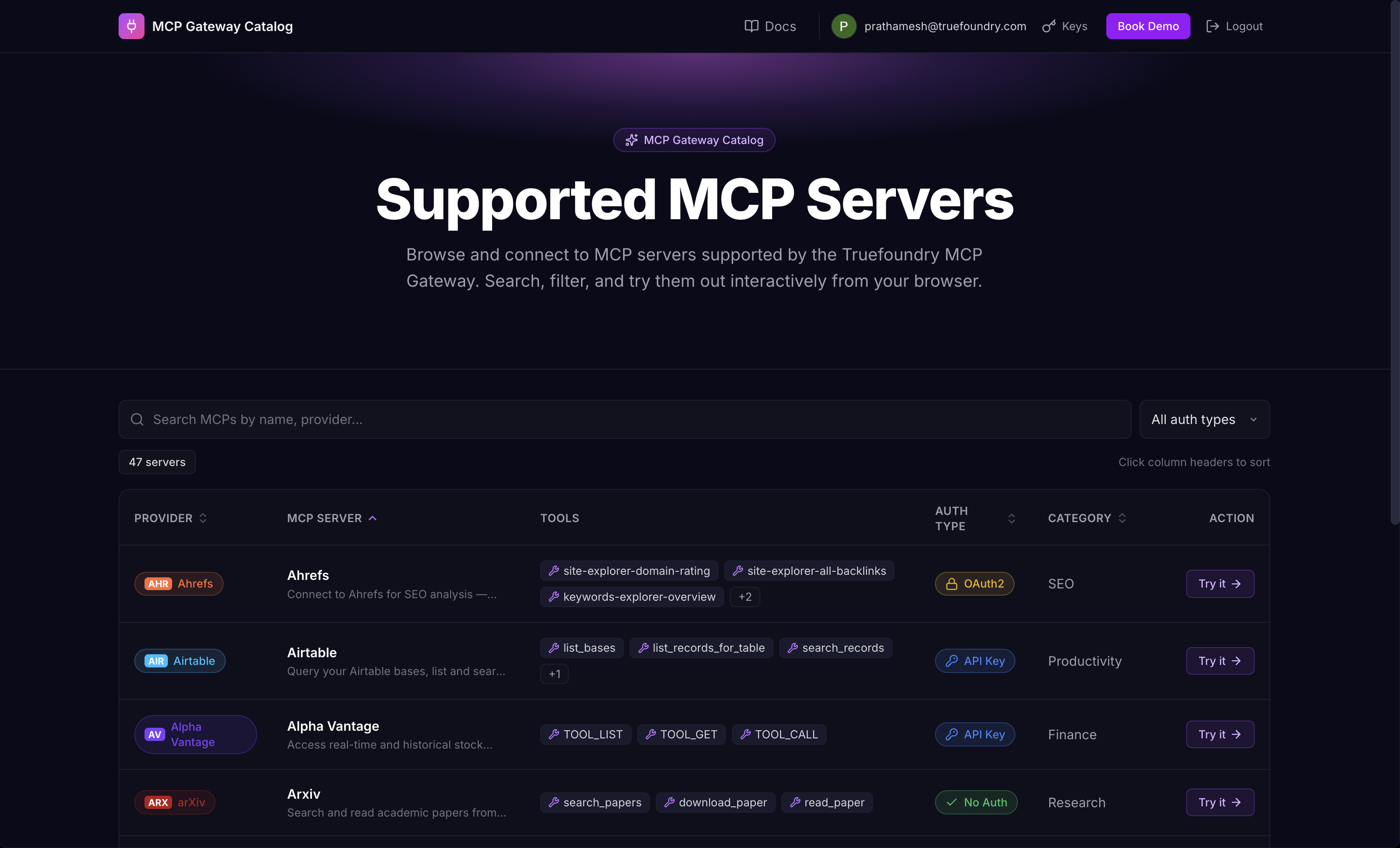
A live product surface that lets any team browse 47+ Model Context Protocol servers, complete OAuth or API-key handshakes, and try every tool from the browser, without a local agent host.
Senior FDE · Platform design and delivery
Stack
MCP · Python · FastAPI · React · TypeScript · OAuth2 · API-key vault
Outcomes
- Unified discovery, auth, and invocation across 47+ third-party MCP servers (SEO, finance, productivity, research, project management, and more) from a single browser surface.
- Three auth modes (OAuth2, API key, anonymous) routed through one consistent UX so consumers don't need per-provider wiring.
- An interactive 'Try it' surface that lets engineers exercise any registered tool against real providers without standing up a local agent host.
What I owned
The platform-side design: how dozens of independent MCP servers get registered, normalized, authenticated, and exposed through a single gateway, and the product surface that makes that registry usable from a browser instead of a CLI.
What shipped
A public, browsable catalog of 47+ MCP servers across SEO (Ahrefs), data (Airtable, Alpha Vantage), research (arXiv), project management (Atlassian), productivity, finance, and more. Each entry carries its auth contract on its face (OAuth2, API key, or anonymous) and exposes its tool surface inline. A consumer can search, filter by auth type, and exercise a tool live from the browser without installing or hosting anything locally. The catalog sits on top of a gateway that does the boring-but-load-bearing work: credential brokering, request signing, transport multiplexing, and uniform error surfacing.
Lessons
The interesting part of MCP isn’t the protocol, it’s the fan-out. Once you have ten servers, none of your consumers want to learn ten different auth flows, ten different rate-limit shapes, or ten different “is this thing alive” semantics. A gateway with a real catalog UI in front of it is what turns “MCP servers exist” into “MCP servers are useful.” Keeping the registry, the auth broker, and the try-it surface on the same product seam is what makes adoption cheap.